AWAKENING 101
Like Reddit and Quora YAHOO: Answers is an online internet question answer forum. Sometime back the following question was asked on YAHOO: Answers:
Are there any online Buddhist teachers?
Not long after the question was posted on the Yahoo site, one Arjuna Ranatunga replied. Arjuna, who goes by the screen name Goodfella, and who holds an earned Master's Degree in Buddhist Studies with Merit from the University of Sunderland, North-east England (2011) as well as a YAHOO: Answers respondent for over 15 years offered the following:
The most famous site with perhaps the most integrity is "Awakening 101", authored by "the Wanderling". I met an Enlightened person who'd used it in His approach / initial studies / on His journey.
It has facilities to ask questions of the Wanderling, too.
Best Wishes in your Quest, Friend,
Arjuna
Please note the second of the two links above has been sub-planted from the original post with two additional albeit equivalent links. The site initially
so cited by Arjuna had not been kept current within it's own links.by the site originator, although a recent check has shown otherwise, hence it's return.
AWAKENING 101 is a FREE, self-paced online Dharma course arranged in such a way as to assist in easing the Dharma Gate for spiritual explorers, seekers along the path, wanderlings, the simply curious, and others who may be so interested.
AWAKENING 101 was originally thought up, assembled, put together, invented and maintained on a variety of websites by the Wanderling. Currently the main aspects of the course are being revamped and updated with new pages being composed, links being reconnected, and lost pages being restored. It will just take awhile as there are hundreds of links and pages to sort through.
AWAKENING 101 UPDATE:
Nearly all the pages used in AWAKENING 101 have now been edited, rewritten, or updated along with almost all of the links. The links giving trouble are mostly third party links usually related in some fashion to confirmations of my sources. Pages just disappear, change URLs, and some authors, tired of being bothered by people contacting them after running into their pages linked on AWAKENING 101 ask me to stop linking --- in turn requiring me to find alternative sources --- sometimes difficult if a specific quote or a specific author's idea is used in my pages to back-up some thesis or the other I am presenting.
So said, at this point I have no real plans for putting AWAKENING 101 back online. Even though I cannot seem to emphasize enough that one's mind must be ripe, I get no end of discontent from people over the fact that after reading a few pages of AWAKENING 101, Enlightenment failed to manifest itself in an easy unimpeded fashion. To ease the path and smooth the way beyond the impediments towards the right frame, that is striving towards your mind being ripe, please see the following, preferably for better understanding, in numerical order:
- ZEN ENLIGHTENMENT: The Path Unfolds
A seeker along the path writes of things Zen and his spiritual mentor who was neither teacher nor guru, but the real life person W. Somerset Maugham wrote about in "The Razor's Edge."
- THE MENTOR: From William Somerset Maugham's The Razor's Edge
Explores who W. Somerset Maugham's main character Larry Darrell in "The Razor's Edge" was in real life and what happened to him post novel.
- SRI RAMANA MAHARSHI: The Last American Darshan
Recounting a young boy's nearly instant transformation into the Absolute during his only darshan with the Maharshi
- THE MEETING: An Untold Story of Sri Ramana
Putting into place the super-normal perceptual state called Siddhis in Sanskrit, Sri Ramana meets a former disciple thousands of miles away from the ashrama.
- DOING HARD TIME IN A ZEN MONASTERY
An American Zen adept ends up high in the mountains in an ancient Chinese Zen monastery, faced with stark, unfettered study-practice that harkened back to Bodhidharma, Hui Neng and the Buddha.
- RETURN TO THE MONASTERY
Describes the events incurred as two monks are sent by the monastery's master to retrieve a lost member of their own, requiring invoking the supernormal perceptual states known as Siddhis to do so.
- DARK LUMINOSITY
An Enlightenment experience in the Zen tradition.
See as well DREW HEMPEL AND THE WANDERLING where the following is found:
I do not claim to be a teacher, if anything I just shovel piles of defecated nitrogenous waste deposits out of the barn so the cows can have more space to move around in. After I have shoveled it out, that same defecation so shoveled, if used the right way by the right people and in the right places as manure, can contribute toward making flowers bloom or nourishment to be consumed. As chronicled in Riding The Cab Forwards I tell about me as a young boy being on a remote dirt landing strip in the desert along the east side of the High Sierras during the middle of the night waiting with my uncle and the pilot to transport a mysterious woman from Reno to Las Vegas. When she showed up the pilot had the vehicle that brought her swing around behind the plane and shine the headlights down the strip. Then, just before he got in the plane, fired up the engine and we took off, he walked the landing strip one more time kicking rocks out of the way he didn't like. Like the pilot I kick rocks out of the way so the path can be made clear making it easier --- for those who may be so interested --- to soar.
CRITICAL CONCERNS WITH AWAKENING 101
MORE CRITICAL CONCERNS WITH AWAKENING 101
HEADSPACE OR CALM FOR MEDITATION: NEEDED OR NOT NEEDED?
A CHILD OF THE CYBER-SANGHA: ENLIGHTENMENT FROM THE INTERNET?
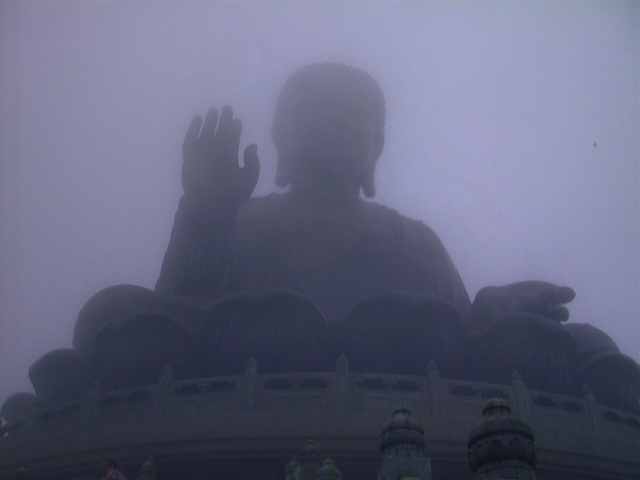
Fundamentally, our experience as experienced is not different from the Zen master's. Where
we differ is that we place a fog, a particular kind of conceptual overlay onto that experience
and then make an emotional investment in that overlay, taking it to be "real" in and of itself.
(PLEASE CLICK)
GASSHO
(please click)
HOW TO GET IN TOUCH WITH THE WANDERLING:
As most of you know, if an email address can be readily scaned by search engines the next thing you know you can't even find the legitimate mail in your box. Hence, the why of how difficult I've made it. Below I offer some suggestions on how to get any number of your questions or concerns along the path answered. However, if you feel a message or personal response would be helpful in your endeavors, e-mail me through EITHER the Wanderling link directly below and follow the steps OR the Blog link below that. On the Blog just leave whatever you want using the Comments form. As to the Email, be advised your message could be lost in the shuffle or forgotten to death as there are a number of SPAM FILTERS IN PLACE that block just about everything --- BUT, and this is the secret, if you type AWAKENING 101 --- in capital letters with a space between AWAKENING and 101 --- in the subject line of your email it has a much better chance of being sorted out of the tons of unsolicited material and actually be read rather than being blocked or deleted:
E-MAIL
THE WANDERLING
(please click)
Also please be advised that I do not, that is DO NOT have any Facebook pages directly attributable back to me in any way, shape or fashion. Any Facebook page implying they are ME or MINE in some manner are done so by others on their own accord and without my sanction. Any poster thereof thinking I will read or respond to posts by anyone are mistaken. I don't go to the pages, I don't read the posts nor do I have any access to respond. Any responses to any posts have not been done by me.
On occasion people DO email me about Enlightenment, the Awakening process and any results thereof. For some of the most interesting go to:
GETTING LETTERS AND EMAILS
.
ENTER ANY ZEN OR BUDDHIST RELATED WORD OR TERM IN THE GOOGLE SEARCH ENGINE BELOW ALONG WITH THE WORD WANDERLING IN QUOTES, I.E., "WANDERLING", AND SEE WHAT COMES UP
If in using the searches above as suggested and what you seek is not forthcoming in the fashion you desire, OR if you simply wish to email or contact me, again, please feel free to do so. Remember, in your quest, and for life in general, if the intent of your actions carries within it the RIGHT escort, any downstream outcomes from such endeavors will in their context, deliver the strength of favorable impulses as they unfold.
CLICK
HERE FOR
ENLIGHTENMENT
ON THE RAZOR'S
EDGE
As to the subject of donations, for those of you who may be interested in doing so as it applies to the gratefulness of my works, I invariably suggest any funds be directed toward THE WOUNDED WARRIOR PROJECT and/or THE AMERICAN RED CROSS.
|